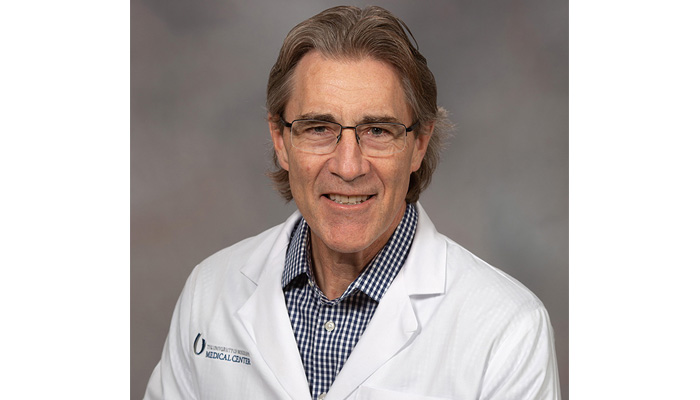
Dr. John Spurzem
Robert Wise: Tell me about your medical practice and training.
John Spurzem: I am an internist, trained in Pulmonary and Critical Care Medicine. I practice at UMMC in intensive care. I also see patients in pulmonary clinic, including cystic fibrosis patients. I received my medical degree from the University of California, Irvine, California College of Medicine. I’ve been practicing medicine now over 40 years.
Robert Wise: What involvement have you had in treating UMMC Covid patients?
John Spurzem: Most of my involvement has been in the intensive care unit. During the first peak period of Covid cases we had a special ICU team for the Covid patients. In the later peaks we had multiple teams caring for Covid ICU patients. I also follow some patients in clinic that have post-Covid lung disease.
Robert Wise: How did the Covid crisis begin at your medical center?
John Spurzem: Last year in early November we were hoping that cases would stay low, but after Thanksgiving and into the Christmas season we had a surge.
Robert Wise: I’m concerned we could see the same thing happen this year among the unvaccinated. And then there was the large surge last summer. If a person walked through the critical care unit during one of the surges, what would they have seen?
John Spurzem: Our ICU was crowded. The hallway had more equipment than usual. The staff arranged the rooms so that the infusion pumps that control medication infusions were in the hallway, with longer tubing. That way, nurses could change a bag of medicine without having to dress up in PPE, saving time and PPE.
Robert Wise: Do you have a sense of how many of the patients were unvaccinated?
John Spurzem: Almost all our ICU patients are unvaccinated. We have treated a few that were vaccinated and had medical issues putting them at very high risk such as having had an organ transplant. A recent study funded by the CDC showed that when breakthrough infections occur in vaccinated persons, vaccination greatly protects against more serious illness and death.
Robert Wise: In vaccination rates, Mississippi ranks third from the bottom of states at number 48. Indeed, the percentage of Mississippians remaining completely unvaccinated is 46%. With 46% completely unprotected, what are your concerns?
John Spurzem: My main concern is for vulnerable family members. Studies show that vaccination not only helps protect the individual but protect family members from infection, and breakthrough infections. I am disappointed in the decision process for many unvaccinated persons. I see it as a selfish decision, that does not consider the benefits of vaccination for their loved ones, and the community at large.
Robert Wise: News is out among the unvaccinated that there will soon be anti-viral pills to lessen the course of the disease. What do you say to the unvaccinated who are just hanging on for the antiviral pills to become available?
John Spurzem: I would say that the vaccine is still a safer bet. It prevents a lot of symptomatic infection and reduces mortality over 10-fold. The new pills will be important for sure, but why take the chance.
Robert Wise: Nationwide, only 1% of seniors 65 and older still have not had a Covid shot. Yet, in Mississippi fully 12% of seniors remain completely unvaccinated. Should they be concerned?
John Spurzem: Yes, Seniors are at higher risk for severe disease. The more people around them that are vaccinated, the better protected they are.
Robert Wise: Last summer’s surge was the worst yet for Mississippi, and we all saw the extraordinary steps UMMC took to meet the demand for critical care.
John Spurzem: Yes, the last big surge was different from the initial surge. Initially, early in the pandemic, there was much anxiety about the unknowns of the disease. We participated in conference calls with critical care doctors in New York and Seattle to try and determine what was working, what was not working. Our multidisciplinary teams developed protocols for treating Covid that were updated every few weeks. In the last big surge, I felt less uncertainty about how we were treating patients but the situation was more demoralizing. Mainly because the surge was unnecessary. We could have prevented most of it with better vaccination rates.
Robert Wise: What will it take to end the Covid surges so we can all get back to normal?
John Spurzem: The Covid pandemic may change what we consider normal. For example, thousands of people would die every year from influenza, and we became accustomed to this. So, we may have to get used to the idea that new Covid variants like the new Omicron one will be circulating every year. We will have to hope for vaccines and medications.
Robert Wise: You shared with me a study recently appearing in JAMA Internal Medicine, from the American Medical Association, that says getting family members vaccinated can be important to help protect the entire family. Tell me about that study.
John Spurzem: It is an interesting study from Sweden. The Swedes have a national database for vaccinations allowing them to study many thousands of persons. They studied unvaccinated persons living with family members. The risk of getting Covid disease decreased if the other family members were vaccinated. The protection ranges from 45% for a small family, to 90% if the unvaccinated person lives with 4 or 5 vaccinated family members. My guess is that the protection will also extend to breakthrough infections. The more family members that are vaccinated, the fewer breakthrough infections will occur in the family.
Robert Wise: Do you find yourself counseling patients to have their family members vaccinated to decrease the risk of Covid to the whole family?
John Spurzem: Yes. I always recommend to my patients that as many family members be vaccinated as possible.
Robert Wise: What can you say from your experience as a pulmonologist who has treated covid patients that would help convince someone to get the covid vaccine?
John Spurzem: I tell patients that vaccines are not risk free. However, these new mRNA vaccines are some of the safest we have. The chief point is that getting Covid disease carries a much greater risk for chronic illness. I follow some patients in clinic that may never regain the lung function they had prior to their Covid illness. I do not have any patients in clinic with complications of the vaccine.
Robert P. Wise is a Northsider.